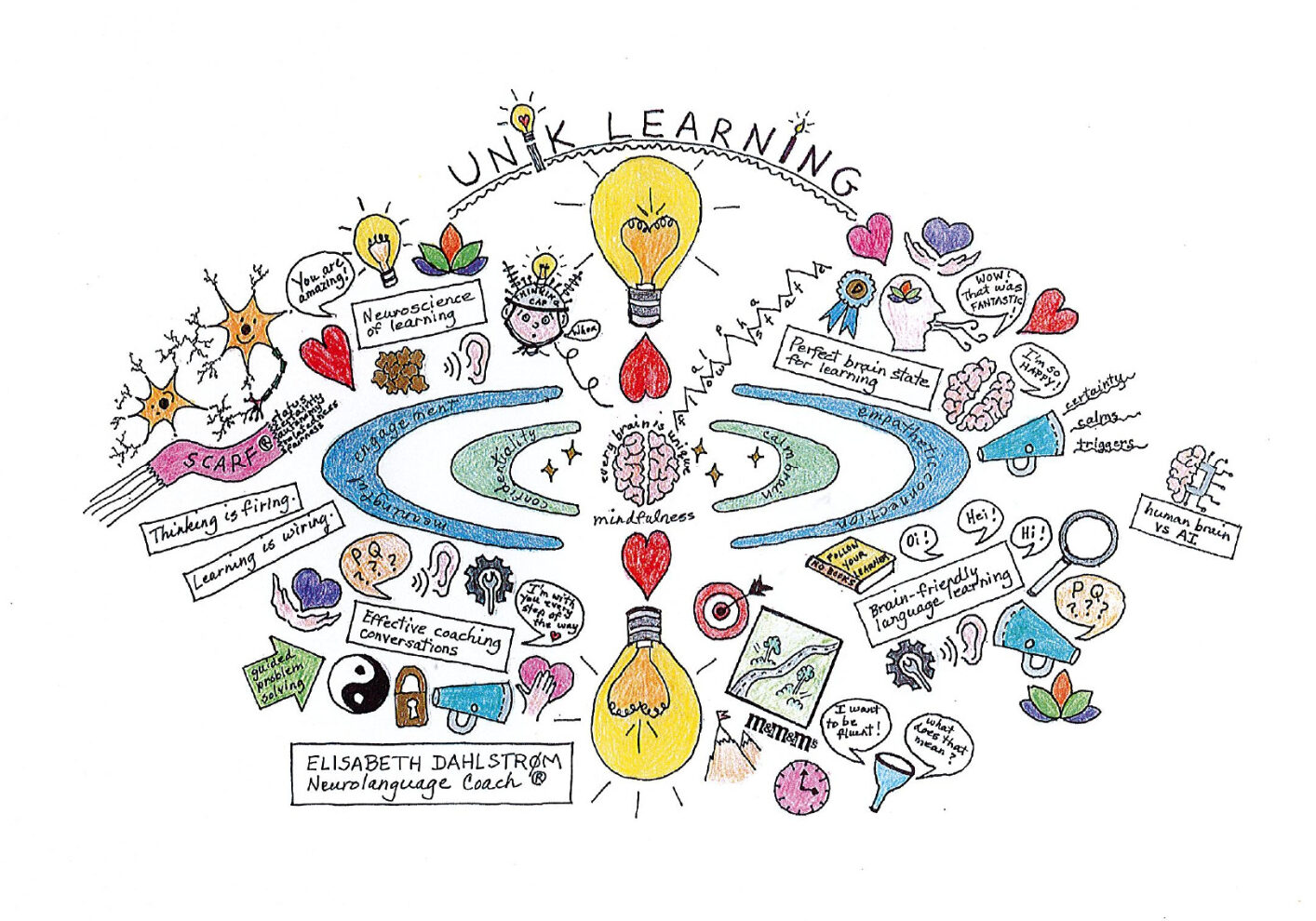

Neurolanguage Coaching®
WHAT IS NEUROLANGUAGE COACHING® AND HOW IS IT TRANSFORMING LANGUAGE LEARNING?
As a Neurolanguage Coach®, my unique style of delivery is with brain-friendly, coaching communication.
Since Neurolanguage Coaches® are ICF (International Coaching Federation) accredited, we bring elements from the coaching profession:
- ICF standards – ethics, guidelines, competences, principles
- Structure – goal setting, action setting, motivation, commitment, goal review
We have the ability to spontaneously troubleshoot, and to coach emotional triggers as well as blocks related to language.
We also have the ability to coach and troubleshoot around the learning process (for example – commitment).
Neuro implies the integration of neuroscience, emotional intelligence, and psychology.
Since every brain is different, we create a unique personalized road map for each learner and diagnose how that particular learner learns.
We strive to understand how the learner thinks, functions, and reacts.
We provoke and connect the learner to associate across languages.
We bring out, when necessary, golden nuggets from neuroscience.
We create the bridge between neuroscience and educational practice.
The process has a totally different structure to traditional language learning.
Everything in the Neurolanguage process follows how the brain learns best.
The unique models used are the 3Ms, 5Cs, PACT PQC, and PROGRESS.
Neurolanguage Coaching®
WHAT ARE THE BENEFITS OF NEUROLANGUAGE COACHING®?
• More efficient and effective
• No books (we don’t follow books – we follow each learner)
• Learner discovers their own way
• Process generates full autonomy/empowerment
• Learners feel certainty
• Whole process is brain-friendly
• Endless increase of self-awareness
• Equal status of the coach and coachee
• Life-changing learning experience
• Focus on cost effectiveness
• Potentially faster language learning
• Provoking continuous “aha” moments with the language
• Content and input always dependent on learner´s wishes
Neurolanguage Coaching®
HOW DID NEUROLANGUAGE COACHING® EMERGE?
Neurolanguage Coaching® was created by Rachel Paling, a visionary British entrepreneur who has revolutionized language education. Paling began teaching languages at the age of 17 and holds a BA Honours in Law and Spanish, an MA in Human Rights, an MA in Applied Neuroscience, and is a qualified UK lawyer and a PCC ICF Life Coach.
In 2008, she founded her company Efficient Language Coaching. Between 2000 and 2012, while working as a corporate and private language coach, Paling gained profound insights into language learning. Gradually, she developed a new concept that integrates professional coaching with neuroscientific principles, emotional intelligence, and neuropsychology – Neurolanguage Coaching®.
In 2012, Paling solidified this innovative approach, and the following year she launched a certification program to train language teachers worldwide. This program became the first language teacher coaching course accredited by the International Coaching Federation.
Today, there are approximately 1,800 Neurolanguage Coaches® in 84 countries, significantly impacting their learners. Neurolanguage Coaching® training is now delivered by 33 teacher trainers in 12 languages globally, with aspirations to integrate this methodology into schools and educational systems, fundamentally transforming language teaching. Paling’s ultimate vision is to empower teachers and educators to become catalysts for change in educational systems worldwide.
Neurolanguage Coaching®
HIGH QUALITY AND EXCELLENT PRACTICES
Neurolanguage Coaches® are certified by Efficient Language Coaching created by Rachel Paling, and accredited by the ICF – International Coaching Federation. Neurolanguage Coaching® has CPD – Continuing Professional Development – registered provider status. Our clients can have complete confidence that learning a language through Neurolanguage Coaching® has been externally assessed for high quality and excellent practices.
The ICF is the most recognized global organization for high quality professional coaching and sets the guidelines, standards, training competences, and ethics for the coaching profession.
The CPD is the term used to describe the ongoing process of improving skills and competences to enhance professional performance throughout one’s career.
A “UNIK” MIND MAP
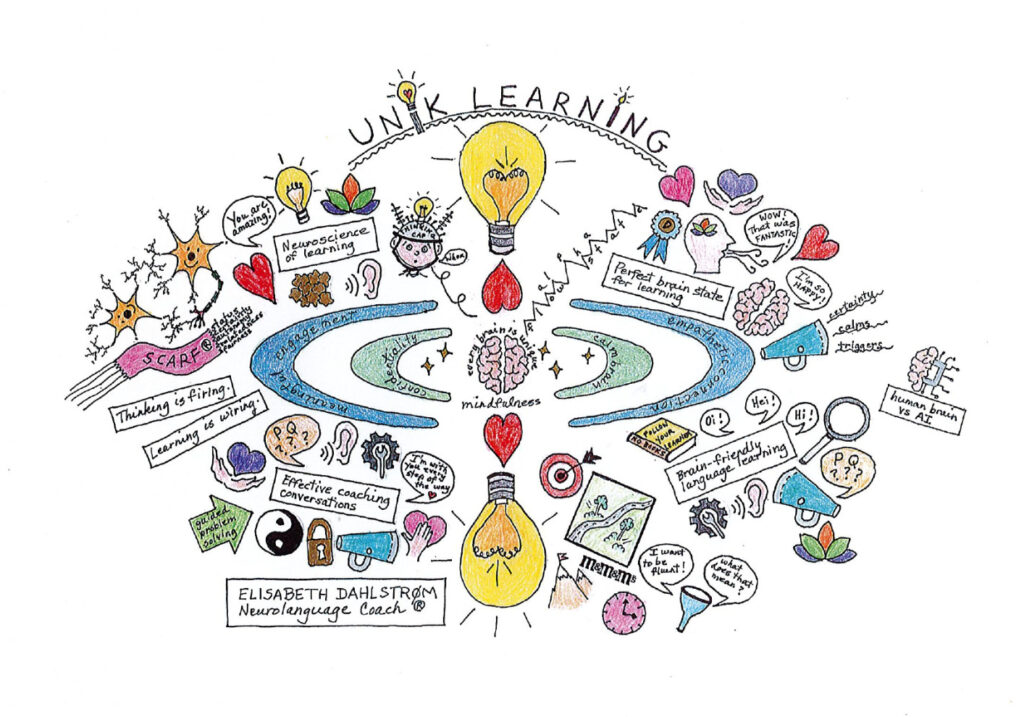
The unique logo for UNIK LEARNING is a mind map I designed using the minfulness symbol. It conveys the essence of Neurolanguage Coaching® through brain-friendly images and words.
Mind maps can be an effective way for many people to comprehend information. We associate and remember images because they utilize a wide range of brain skills, especially imagination. Images can be more evocative than words, triggering a broad spectrum of associations, thus enhancing creative thinking and memory. These findings support the argument that the mind map is an ideal tool. It not only uses images; it is an image!
Mind maps have a natural organizational structure that radiates from the center, incorporating lines, symbols, words, colors, and images according to simple, brain-friendly concepts. Mind mapping converts a large amount of information into a colorful, memorable, and highly organized diagram that aligns with our brain’s natural way of processing information. Mind maps have the power to push our creative thinking further, leading to greater insight and innovation.
Logo
WHAT IS FOUND IN THE MIND MAP?
• Active listening – ear
• Aha moment – light bulb
• Alpha brain waves – zigzag brain waves
• Book – no books
• Breathing – curly lines
• Calm and Self-regulation – lotus
• Certainty – scarf
• Chunking – magnifying glass
• Coaching conversations – speech bubbles
• Compassion – heart
• Confidentiality – padlock
• Empathy – hands with heart in them
• Feedback – speech bubbles / reward ribbon
• Glimmer – four-point star
• Goals – bull’s eye in target
• Golden nuggets – chunks of gold
• Honesty – hand over heart
• Language connections – speech bubbles in different languages
• Metacognition – child with a thinking cap
• Mindfulness – background symbol
• Motivation – mountain with flag on top
• Neurogenesis and neuroplasticity – neurons and neural circuits
• Non-directive coaching approach – thick arrow
• Powerful questions – in coaching conversations
• Road map – road map
• Signposting – megaphone
• Troubleshooting – wrench and gear
• Yin yang – symbol
Logo
WHAT COULD THESE MEAN FOR YOU?
ACTIVE LISTENING requires listening attentively to a speaker, understanding what they’re saying, responding and reflecting on what’s being said, and retaining the information for later. This keeps both the listener and speaker actively engaged in the conversation, and it is an essential building block for a compassionate relationship. Active listening requires mastering skills such as reading body language and tone of voice, maintaining attention, and being aware of and controlling emotional responses. It is when you not only hear what someone is saying, but also being attune to their thoughts and feelings. It turns a conversation into an active, non-competitive, two-way interaction. It is an essential skill.
An AHA MOMENT is a moment of sudden realization, inspiration, insight, recognition, or comprehension.
Harnessing your brain’s ALPHA WAVES can help you enter a flow state, which allows you to do deep work with less effort. Alpha waves induce feelings of calm, increase creativity, and intensify your ability to absorb and maintain new information. They also enhance cognitive function and improve working memory.
We do not follow BOOKS, we follow our learners. Through coaching techniques, they discover their own way of learning. Books can be used for self-study.
Mindful BREATHING exercises have many cognitive benefits, including increased ability to focus, decreased mind wandering, improved alertness levels, more positive emotions, and decreased emotional reactivity. They improve memory, attention, focus and concentration, making it easier for learning to take place.
Keeping CALM throughout the learning process is essential, and this often requires SELF-REGULATION, the ability to stay calmly focused and alert by means of self-control. It involves developing the ability to regulate your emotions, thoughts, and behaviour to enable you to act in positive ways toward a goal. In order to self-regulate, you must take a pause between a feeling and an action, and take the time to think things through, make a plan, and wait patiently.
CERTAINTY refers to our brain’s inherent desire to predict what will happen in the future. When learners have a sense of certainty, they feel more comfortable and secure, and are better able to focus on their learning. Certainty reduces stress and anxiety, improves decision-making, increases productivity, leads to better communication, and enhances motivation. David Rock’s SCARF® model highlights five key dimensions of social experience that can trigger either a reward or threat response in the brain. Among them, certainty is one of the most vital for maintaining a positive and productive learning experience.
CHUNKING – Chunking down is zooming in. It is focusing on the detail and getting more and more specific. Chunking up is zooming out to see the bigger picture, having an overview of the whole, and possibly beyond. Chunking is a quick and simple way to help reduce stress and overwhelm, as well as become more productive and effective. The essence is very simple: “How do I need to think about this so it works better? Do I need to zoom in or out? ”
Flowing, insight-provoking, empathetic COACHING CONVERSATIONS are used throughout the ongoing sessions, with great focus on the established goals and actions, as the coach and coachee work towards accomplishing desired outcomes. The non-directive, brain-friendly coaching conversations ensure that the brain is in a very calm state which in turn creates an efficient learning process.
Showing COMPASSION involves making someone feel valued and cared for. In the brain it activates the pleasure circuits and strengthens the reward circuits, making us feel happy. When cultivated with learners, they become more resilient, interested, and motivated to learn, which leads to higher achievement in the learning process.
CONFIDENTIALITY is keeping sensitive information private and respecting someone’s wishes. It means that professionals should not share personal details about someone with others. It is the state of being secret.
EMPATHY is the ability to emotionally understand what other people feel, to see things from their point of view, and to imagine yourself in their place. Essentially, it is putting yourself in someone else’s position and feeling what they are feeling.
Neuroscience suggests that people respond more favorably to positive FEEDBACK than negative threats. Positive feedback activates the brain´s reward circuit. The brain is then encouraged to repeat the same task to be able to feel the rewarding dopamine “high” again and again, so learners become more willing to complete a hard or stressful task than they otherwise would without the positive feedback recognition.
A GLIMMER is the opposite of a trigger. Glimmers are tiny moments of awe that spark joy and evoke inner clam. They are micro moments that bring feelings of ease, contentment, and hope.
GOALS are important because they provide clarity, motivation, measurement, accountability, and a sense of achievement. They provide a clear road map for where you want to go and what you want to achieve. Setting goals is an effective way to increase motivation and focus, and create new behaviors, which lead to greater success and performance.
The GOLDEN NUGGETS are pieces of information from neuroscience that are used to enhance healthy brain activity and maintain the brain in a state of calmness, promoting the ability to self-regulate through emotional triggers.
HONESTY is righteousness, integrity, and truthfulness. It is important to be truthful about your thoughts, feelings, and actions in order to create a foundation of trust, and essential for building healthy relationships.
Making LANGUAGE CONNECTIONS is essential to learning a language and can be done by provoking and connecting the learner to associate across languages.
METACOGNITION is being aware of and in control of one’s own mental processes.
MINDFULNESS is the basic human ability to be fully present, aware of where we are and what we are doing, and not overly reactive or overwhelmed by what is going on around us. When we are mindful, we reduce stress, enhance performance, gain insight and awareness through observing our own mind, and increase our attention to others’ well-being. The mindfulness symbol is used as a reminder to be present in the moment and to be aware of your thoughts and feelings. In the mind map it is the big background symbol.
MOTIVATION describes why a person does something. It is the internal driving force behind human actions. Motivation is the process that initiates, guides, and maintains goal-oriented behaviors.
NEUROGENESIS (the birth of new neurons) and NEUROPLASTICITY (the flexibility of neural circuits) work together to reshape how we think, remember, and behave.
A NON-DIRECTIVE coaching approach emphasizes active listening, summarizing, and guiding the coachees towards solving problems for themselves. It involves recognizing and valuing the coachee, and encouraging self-expression, self-awareness, self-development, and a greater understanding of self.
The POWERFUL QUESTIONS used in the coaching conversations, especially in teaching grammar, help facilitate neural connections. One way of doing this is by using powerful coaching questions, and the other is by asking how the learner’s native language is or is not linked to the target language in order to trigger associations and patterning.
A ROAD MAP is a plan or strategy intended to achieve a particular goal or set of goals and includes the major steps or milestones needed to reach it/them.
SIGNPOSTING is announcing what is coming. It is a powerful tool that helps engage learners and keep them focused on a topic. It is also important in that it provides safety and certainty in knowing what will come next which in turn creates calmness in the brain.
TROUBLESHOOTING is to locate the cause of a problem and remove or treat it (for example – with learning).
YIN YANG is the symbol of balanced energy, with no single element dominating over or being superior to the other. It reminds us that there is harmony through balance. Such is it with the coach and coachee – equal status.