JOYFUL LEARNING

Joyful Jots

A collection of little reflections, jotted from the heart

JOYFUL SOUND SPARKS

Hear it. Say it. Feel it. Let them spark!

🧠 What Are Neurons — and What Do They Do?

Inside your child’s brain, heart, and gut, there are millions of tiny messengers called neurons. They help your child learn, feel, move, and grow — by sending signals and building powerful connections.

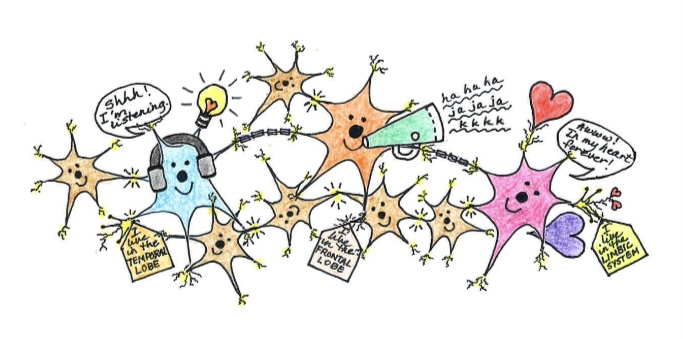
In Joyful Sound Sparks, the focus is on three special neurons that live in the brain.

When your child hears, says, and feels a sound — like “splash,” “achoo,” or “ha ha ha!” — this joyful brain team lights up and goes to work.

Together, they help turn everyday sounds into language, meaning, and memory — all through play!

Auditory processing

What it does:

The Listener Neuron picks up the sound your child hears and quickly sends it to the brain’s auditory center.
It helps recognize what the sound is — a laugh, a sneeze, a dog bark — and tells the brain,

📣 “Hey! We’ve heard this before!”

Where: Temporal lobe (auditory cortex)
Why it matters: This is the first step in making sense of language

Talking, sounding out words, and making silly voices

What it does:

The Speaker Neuron helps your child say the sound out loud!
It tells the mouth and tongue how to move — and makes “achoo!” or “moo!” or “woof!” come to life.

📣 “Let’s try saying that sound!”

Where: Frontal lobe (Broca’s area)
Why it matters: Speaking strengthens memory and makes language active and fun.

Emotional connection + memory

What it does:

The Feeler Neuron connects the sound to emotion and memory — making it meaningful.
It helps your child feel joy when laughing, comfort from a “purr,” or surprise at a “pop!”

📣 “That sound makes me feel something!”

Where: Limbic system (amygdala + hippocampus)
Why it matters: Emotion helps language stick in the brain — especially through joy.

✨ What Happens When They Work Together?

When all three neurons work together during playful sound experiences:

🎧 Your child hears the sound
🗣️ Then says or acts it out
💖 Then feels something and remembers

That’s when a joyful language spark is born —
and strong, lasting brain connections begin to grow!

🎉 Kid-Friendly Version:

Meet the Sound Neurons!

  • Blue hears the sound.
  • Orange says the sound.
  • Pink feels the sound.       

💥 Together, they make your brain light up with joy!

Because when your child hears it, says it, and feels it — language doesn’t just stick… it sparks!

Helping Your Child Thrive in Two Languages

When young children are learning more than one language, it’s not just their brain that’s working — it’s their whole self. They learn with their mind, their emotions, and even their intuition.

In fact, science now shows that children, and adults alike, have three powerful “intelligence centers”:

     🧠 the brain (thinking)

     💓 the heart (feeling)

     🦠 the gut (instinct)

When all three are supported, your child can grow up feeling confident, connected, and proud of speaking more than one language.

Here’s how each part plays a role — and how you can help.

About 86 billion neurons! Your child’s brain is incredibly flexible, especially in the early years. It absorbs sounds, patterns, and meanings from both languages at once — like a sponge! Bilingual children actually use more areas of the brain when processing language.

💡 Support tip: Talk, sing, and read in both languages. Let your child hear rich, natural language from people they trust.

About 40,000 neurons in the heart's own nervous system! The heart is where your child feels love, safety, and belonging. If a child is scared or feels “different” for speaking another language, the heart can close up — and learning slows down.

💡 Support tip: Celebrate both languages at home. Show pride in your child’s cultural identity. Let them feel seen and safe to speak freely.

Over 100 million neurons in the gut’s “second brain”! Even young children have a strong “gut feeling” about what feels right or wrong. Their gut helps them decide which language to use with whom — and when it’s okay to try, or when it’s safer to stay quiet.

💡 Support tip: Don’t pressure your child to speak one language over another. Let them lead. If they go quiet, be patient — they’re listening, learning, and sorting things out in their own time.

What really helps your child thrive?

💡 Loving connection in both languages

💡 Patience with their language journey

💡 Confidence to speak, make mistakes, and try again

💡 A sense of belonging in both worlds

🧠💓🦠 Your child is learning with their whole self.

Support their brain, nurture their heart, and trust their gut — and they’ll blossom as confident, compassionate bilingual communicators.

The best kind of learning happens when your child’s brain, heart, and gut are all in sync — and you’re a key part of that!

Thank you for all the love, patience, and support you bring to their learning journey.